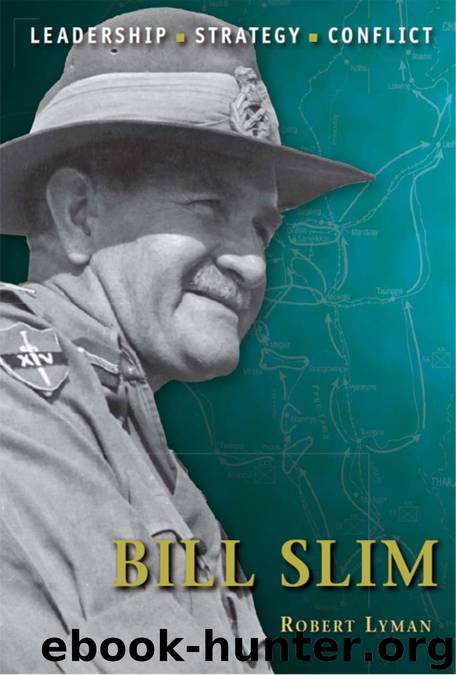
Bill Slim by Robert Lyman
Author:Robert Lyman
Language: eng
Format: epub
Tags: Bill Slim
ISBN: 9781849088688
Publisher: Osprey Publishing Ltd
Published: 2019-11-24T16:00:00+00:00
Slim with Lady Aileen Slim at Imphal after the ceremony. (IWM, SE 2716)
By September 1944 the climate had improved sufficiently for Mountbatten to secure from the Octagon Conference, meeting in Quebec, an extension of the earlier mandate. On 16 September he was given authority to capture all of Burma, provided that operations to achieve this did not prejudice the security of the air supply route to China. This was much-needed confirmation for Slim of the direction in which he was already heading. Slim was ordered to initiate planning for Operation Capital to be put into effect in December.
He knew that the considerable logistical nightmare associated with relying on land-based lines of communication could in large part be overcome by the use of air supply, a factor that had played a significant part in all his operations to date. He knew also that the Japanese had received a defeat the like of which would make it difficult for them to recover quickly. ‘A second great defeat for that army, properly exploited, would disrupt it and leave, not Mandalay but all Burma at our mercy’ he reasoned. ‘It, therefore, became my aim to force another major battle on the enemy at the earliest feasible moment.’ He found himself faced with his second great chance and he was determined to seize it.
To match the new style of fighting Slim expected once the Chindwin and Irrawaddy had been crossed, Slim appointed Lieutenant-General Frank Messervy – who had commanded the 7th Indian Division in Arakan – to command a reconstructed IV Corps in October 1944. Messervy was also a bold thinker and suggested that one brigade of 17th Indian Division be mechanized and another made air transportable to exploit the new terrain Fourteenth Army would meet once the Chindwin had been breached. Slim agreed and converted 5th Indian Division to the new organization as well. Messervy’s idea proved to be critical both to the success of the seizure of Meiktila in February and in the epic dash to Rangoon in April.
Slim’s plan for Operation Capital necessitated the retraining and restructuring of his Army. Once over the Irrawaddy, the Army would have to fight in a very different style to that which had won it the great victories in Arakan, Imphal and Kohima. After two long years of jungle fighting the wide prairie-like plains of central Burma beckoned, where fast-moving armoured thrusts, large-scale artillery ‘stonks’ and attacks on broad fronts by brigades and divisions would replace the intense but relatively slow bayonet, rifle and grenade struggles by sections, platoons and companies in the half-gloom of the jungle that had characterized the fighting in Arakan and the hills of eastern India. Speed, the massed use of armour, bold flanking movements and the close cooperation of tanks, infantry, artillery and aircraft would define operations in this new environment after the Chindwin had been crossed. To meet this requirement Messervy’s corps comprised 7th and 19th Indian Divisions and 255th Tank Brigade equipped with Sherman tanks, while XXXIII Corps (Lieutenant-General
Download
This site does not store any files on its server. We only index and link to content provided by other sites. Please contact the content providers to delete copyright contents if any and email us, we'll remove relevant links or contents immediately.
Fanny Burney by Claire Harman(26607)
Empire of the Sikhs by Patwant Singh(23090)
Out of India by Michael Foss(16861)
Leonardo da Vinci by Walter Isaacson(13341)
Small Great Things by Jodi Picoult(7156)
The Six Wives Of Henry VIII (WOMEN IN HISTORY) by Fraser Antonia(5519)
The Wind in My Hair by Masih Alinejad(5103)
A Higher Loyalty: Truth, Lies, and Leadership by James Comey(4967)
The Crown by Robert Lacey(4820)
The Lonely City by Olivia Laing(4808)
Millionaire: The Philanderer, Gambler, and Duelist Who Invented Modern Finance by Janet Gleeson(4482)
The Iron Duke by The Iron Duke(4367)
Papillon (English) by Henri Charrière(4278)
Sticky Fingers by Joe Hagan(4207)
Joan of Arc by Mary Gordon(4117)
Alive: The Story of the Andes Survivors by Piers Paul Read(4037)
Stalin by Stephen Kotkin(3973)
Aleister Crowley: The Biography by Tobias Churton(3646)
Ants Among Elephants by Sujatha Gidla(3470)
